The best social media content ideas for a small team in 2026 are ones you can produce again next week from material you already own: customer questions, reviews, footage of the product in use, and what your team knows. Our top pick is the plainest one on the list. Answer one real customer question per week as a post, because the supply never runs out, the topic is guaranteed to matter to buyers, and the answer adapts to every platform you publish on.
The short version
Small teams should post content that answers customers, demonstrates the product, earns trust and invites a reply, using formats they can repeat weekly instead of reinventing them. Start with a weekly customer-question post. Add a recurring series and a carousel explainer, then test short video on TikTok and Reels. Judge every idea by saves, replies, qualified clicks, leads and sales, not by reach.
The constraint is time, not imagination. In Meltwater's 2026 Global State of Social Media report, 59% of respondents named team bandwidth as a social media challenge, up from 56% a year earlier. A list of 100 ideas does not fix that. Twelve formats you can repeat do.
How we chose and ranked the twelve
We build Thetabber for teams that push one campaign out to many networks, so we judged each idea the way those teams work. Four questions decided the order. Does the idea draw from a source that refills itself, like an inbox or a review feed? Can one person produce it in under an hour with a phone and a template? Does it survive being reshaped for Instagram, TikTok, Facebook, Pinterest and LinkedIn without starting from zero? And does it earn an action you can count? Ideas that passed all four sit at the top; ideas that depend on a good week or a willing colleague sit lower. Each pick also does one of five jobs (educating, demonstrating, building trust, showing personality, or prompting interaction), so you can choose by goal rather than by mood.
The customer question you already answered in a DM
This one teaches, and it never runs dry. Every week your customers hand you topics in their own words: in DMs, support emails, product-page Q&A, return reasons, and the comment under last Tuesday's post. One of those questions, answered well and in public, makes a stronger post than anything you will brainstorm in a meeting.
The habit that makes it work is what we call the question bank: a single running document where anyone on the team pastes customer questions verbatim, with the date and the channel they came from. Verbatim matters. Marketers on r/marketing describe ideation going stale until every new concept reads like a lightly edited version of an old post, and that happens because the team is drawing from its own head. Customers phrase things in ways you would never think to, and their phrasing is what other customers search for.
Production is light. Pick the question that showed up most often this week. Answer it as a 20-second talking-head clip for TikTok and Reels, a text-on-image post for Facebook, a pin with the question as the headline, and a short paragraph on LinkedIn if the question touches how the business operates. Close with a prompt to send in the next question, which keeps the bank filling. The same answer later goes on your FAQ page and into a newsletter.
The reshaping step is where small teams lose afternoons, and it is unavoidable, because your audience is spread across several networks. Among small businesses that advertise on social, 85% planned to use Facebook in 2025, 74% Instagram and 46% TikTok, according to Intuit SMB MediaLabs. That one answer is the job we designed Thetabber's publishing tools around: write it once, let AI captions draft a platform-sized version for each network from the customer's own wording, edit what needs editing, and publish to 9+ platforms from one screen. If you worry that AI captions will sound off-brand, the question bank is the fix. Captions built from a real customer's real question come out specific, because the input is specific.
Tip: Tag each entry in your question bank with the product it concerns. When a launch or seasonal push arrives, filter by product and you have a month of pre-validated topics before anyone opens a blank caption box.
Start a recurring series, and let the name do the planning
Where the customer question gives you topics, a recurring series gives you a slot. "Ingredient of the Week." "Fit Check Friday." "What's in the Box Wednesday." Once a series has a name and a day, nobody has to decide what to post on that day ever again, and that settles the question beginners on r/contentcreation ask most: what am I supposed to post every day?
Professionals carry the same problem at a different scale. Social media managers on r/SocialMediaMarketing say they struggle to produce even ten strong days of content in a row, and that the usual sources (AI tools, Google, aimless scrolling) stop helping fast. A series fixes the arithmetic. Two named series posting weekly cover eight days a month before you write a single one-off post, and because the format is fixed, you can shoot four episodes in one afternoon.
Keep the format tight. Same opening line, same visual frame, same closing prompt ("follow for next Friday's pick"). Repetition is the point: viewers learn what to expect and come back for it, and you learn which episodes get saved. At the end of each month, compile the four episodes into one carousel or a blog roundup and you have a ninth post for free. The series to avoid is one that depends on a single person being available every week. Pick a format any team member can run with a phone.
Swipeable explainer carousels
A carousel turns an answer into a sequence: slide one states the problem, slides two through six walk through it, the last slide tells the reader what to do next. It is the format people save, and saves are a better signal of usefulness than likes.
Format matters on Instagram more than most teams assume. The Emplifi 2026 Social Media Benchmarks Report measured carousels and Reels generating about 44% more median interactions than single-image posts. Treat that as a reason to test, not a promise. A median across thousands of brands tells you which way to lean; your own saves after six carousels tell you whether it holds for your audience.
The production trick is to build one template in Canva or Figma with fixed fonts, colors and slide count, then pour new content into it. Source material comes straight from the question bank or a how-to you have already written. Carousels also travel well: the same slides work as a LinkedIn document post and, cut into single images, as a Pinterest set. Six to eight slides is plenty. If you need twelve, the topic is two carousels.
Show the product in someone's hands
Static product shots tell people what something looks like. A 15-second clip of the serum's texture on a wrist, the jacket zipped up on a windy pier, or the sauce poured over rice tells them what owning it feels like, and that is what demonstration content is for.
Short video is where platform attention has moved. TikTok climbed from third to second place in social teams' platform priorities between 2025 and 2026, the Meltwater survey found, and the same report put TikTok ad reach at 1.9 billion, up 17.6% year over year (a reach figure for ads, not a count of active users). Engagement follows the same direction. Emplifi tracked TikTok's median video engagement rate rising about 4% in 2025, landing at nearly twice Instagram's.
The barrier is skill, not equipment: 39% of Meltwater respondents cited limited video capabilities as a challenge, two points worse than the year before. Phone footage in daylight is enough here, since the product is the subject and polish can distract from it.
The how-to tutorial
A tutorial shows the result of using the product correctly: how to layer three skincare steps, how to style one scarf four ways, how to brew the loose-leaf tea without bitterness. It educates, but it also lowers return rates, which is the argument to put in front of a founder who doubts that "educational content" sells anything.
If you already publish blog posts, the tutorial is mostly written. Pull the steps into a short video, a carousel and a pin, and link back to the full post in the caption or bio. One tutorial a month, repurposed into three formats, is a sustainable pace for a two-person team.
Turn a customer review into a story
A five-star review pasted onto a branded tile is a testimonial. A review turned into a story names the problem the customer had, what they tried before, and what changed, with their permission and their first name. The second version persuades because it reads like a person and not a rating.
Trust content earns its place because social is where small businesses sell. Respondents to the SBE Council's Small Business Technology Use Survey 2025 attributed a median 23.5% of their sales to social media and e-commerce platforms combined, and 21% said those channels drove more than half of revenue. That is a combined category, not social alone, but it still means the person reading your review post may be one tap from checkout. Pull reviews that mention a specific use case, and pair the quote with a short clip of that use case.
Customer-submitted content, with permission in writing
User-generated content (UGC) is the photo a customer tags you in, the unboxing video, the "ten days in" update. It works because it shows real people choosing your product. It is also the idea most likely to cause problems if you treat a tag as consent.
Ask, every time, in writing. A DM that says "Can we repost this on our Instagram, TikTok and Facebook with credit to you?" and a reply that says yes is your record. Credit the creator by handle in the post. If you want to use the content in paid ads, ask separately, because organic and paid permission are different requests.
Warning: A customer tagging your brand is not a license to reuse their photo or video. Get explicit written permission covering every platform and use (organic, paid, website) before you publish, and keep the message thread.
Address an industry myth
Every category has one: "natural deodorant doesn't work," "you have to break in leather boots for a month," "frozen vegetables have fewer nutrients." Pick a myth your customers repeat, state it plainly, and correct it with evidence, ideally a statistic or a study you can name. This is where industry news and data earn a slot in your calendar, and where a well-chosen meme format can carry the correction if it suits your brand voice. Myth posts invite disagreement, so plan to stay in the comments for the first hour. Replies are the measure here.
A behind-the-scenes moment
Show the packing table on launch day, the batch of samples that did not pass, the booth setup at a trade show. Behind-the-scenes posts show personality, and small brands have an edge here that large ones cannot fake: the founder is often in the shot. Keep it unpolished and specific. "Packing 340 orders before Friday's cutoff" beats "busy day at HQ."
Introduce a team member
One person, one photo or short clip, three facts: what they do, what they would recommend from the range, and something human. Customers buy from people, and a team introduction gives your support replies a face. Rotate through the team once and then run it as a series when new people join.
Polls versus local spotlights: two ways to get a reply
The last two ideas both exist to start a conversation, and they differ in who you are talking to. Polls, "this or that" stories, AMAs and audience questions invite your followers to weigh in on something low-stakes: which colorway to restock, which flavor comes next. They are cheap to make and the answers feed straight into the question bank. Contests and giveaways belong in this family too, though they work best tied to a launch rather than run on repeat, since a standing giveaway attracts entrants who never buy.
Local spotlights point outward. Highlight a neighboring shop you stock with, an event you are attending, or a question your town is arguing about. For brands with a physical presence or a regional customer base, this builds goodwill a poll cannot, and the partner usually reshares. For a purely online brand, swap "local" for "community": the subreddit or Facebook group where your customers gather. Polls are the better weekly habit; spotlights are the better monthly one.
Measure what a small team can act on
Reach is the easiest number to report and the least useful for deciding what to post next. Three in four small businesses advertise on social media and the same share call it effective (Intuit SMB MediaLabs, 2025), with 48% planning to raise that spend. Yet the SBE Council counted only 57% of small businesses using social media marketing at all, and 30% naming it their highest-ROI channel. Those numbers describe a channel that pays for some businesses and not others, which is why tracking outcomes matters more than tracking views.
Match each idea to the action it should produce. Carousels and tutorials should earn saves. Myth posts and polls should earn replies. Product-in-use clips should earn qualified clicks to a product page. Review stories should show up in leads and sales. Check these monthly, drop the format that loses two months running, and give its slot to the one that wins.
A one-afternoon batching routine
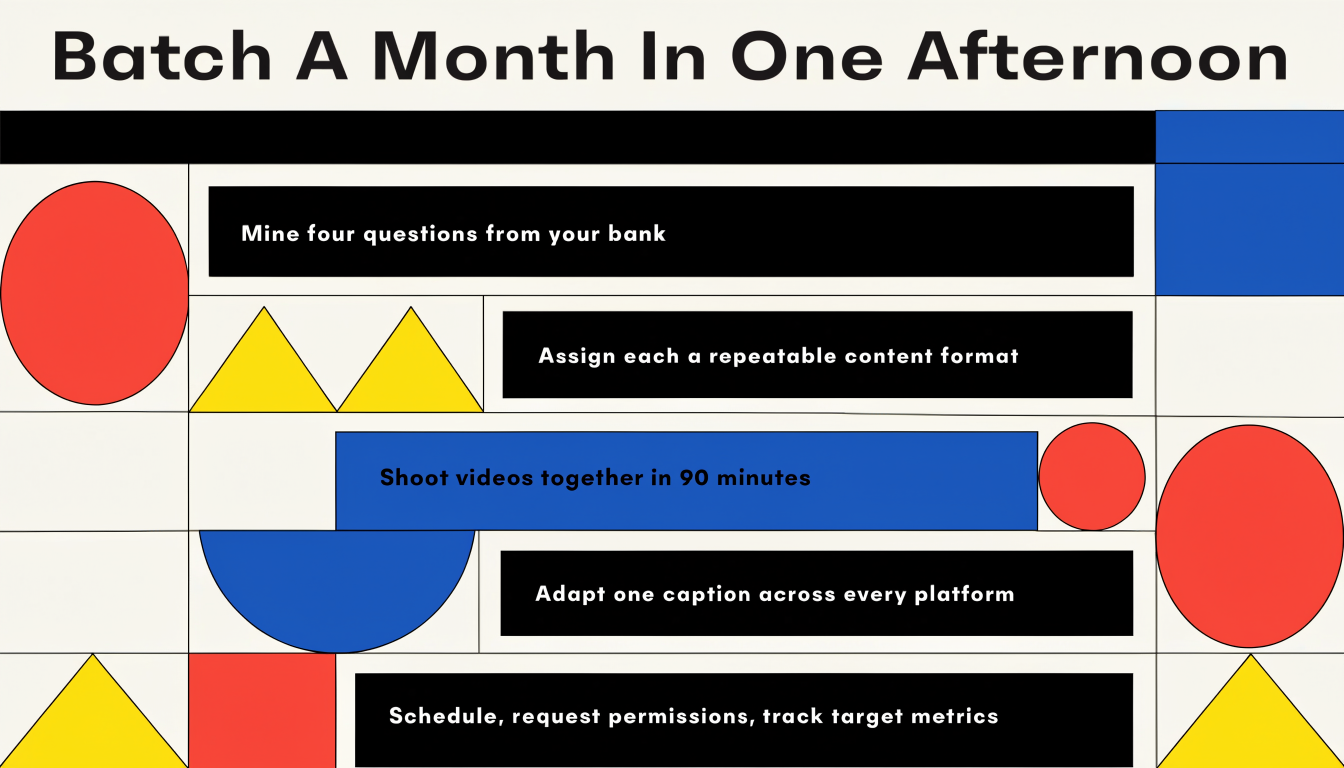
- Open the question bank and pick the four most-asked questions from the past month.
- Assign each question a format: one talking-head video, one carousel, one text post, one tutorial clip.
- Shoot all video in a single 90-minute block, in daylight, with the product on hand.
- Pour carousel content into your saved template rather than designing from scratch.
- Draft one master caption per post, then adapt it for each platform's length and tone instead of pasting it unchanged.
- Request written permission for any customer content before it enters the schedule.
- Schedule the full month, leaving two open slots per week for reactive posts.
- Log the target metric (saves, replies, clicks, leads or sales) next to each post so the monthly review takes minutes.
Picking a scheduler by workflow, not feature count
The routine above assumes a tool that holds a month of posts. Which tool depends on the bottleneck. Thetabber suits teams publishing the same campaign across many networks who want captions drafted per platform, with plans on our pricing page. Buffer is the straightforward choice for a few accounts: the Free plan costs nothing, Essentials is $6 per channel per month, or $5 billed annually ($60 a year per channel), there is a 14-day trial, and each connected account counts as a channel, so Instagram plus Facebook is two. For a team on two or three accounts, that simplicity is a fair reason to stay put. At five channels, Essentials reaches $30 a month ($25 on annual billing), which is when per-channel pricing starts to bite.
Metricool fits teams who want analytics and reporting alongside scheduling. Publer is built around multi-platform scheduling and post customization. Later leans toward visual brands planning a grid and social commerce, and SocialBee is strongest at recycling evergreen content by category.
All twelve at a glance
| Idea | Content job / best for | Rough cost per post |
|---|---|---|
| Answer one customer question | Educating; every brand | 30 to 45 minutes |
| Recurring series | Personality and retention | 20 minutes once batched |
| Explainer carousel | Educating; earning saves | 45 minutes with a template |
| Product in someone's hands | Demonstrating; TikTok and Reels | 30 minutes, phone footage |
| How-to tutorial | Educating; reducing returns | 1 hour, less if a blog post exists |
| Review turned into a story | Building trust | 30 minutes plus permission |
| Customer-submitted content | Building trust; UGC | 15 minutes plus permission |
| Industry myth | Educating; prompting replies | 45 minutes including sourcing |
| Behind-the-scenes moment | Personality | 10 minutes |
| Team member introduction | Personality; humanizing support | 20 minutes |
| Polls and audience questions | Prompting interaction | 5 to 10 minutes |
| Local partner or community spotlight | Prompting interaction; goodwill | 30 minutes |
What did not make the list, and what to start with
Trend audio, standalone memes, live streams and standing giveaways all have their moments, and none of them made the twelve because each fails the repeatability test for a team of two or three: trends expire before you can batch them, live streams need someone free at a fixed time, and permanent giveaways attract followers who never buy. Use them when an opportunity arrives, not as the backbone of a calendar. Start with the question bank this week. Paste in every customer question from the last 30 days, answer the most common one as a post on Monday, and build the rest of the list around what that post teaches you. Our free online tools can help with resizing and trimming as you go.